Sunday, 15 August 2010

The Great Crane Project

 
The Great Crane Project is an attempt to reintroduce this majestic bird back into the UK.  To find out more visit:

 The Great Crane Project

 The Great Crane Project on Flickr  

Cranes and people

from RSPB

Cranes flying across Norfolk Broads to roost

Cranes have enchanted human beings for millennia
  • They figure in prehistoric cave paintings 
  • Homer wrote of their exhilarating sound in the Iliad (first bird mentioned in western literature -  4000 BP) 
  • Roman folklore explains that the god Hermes invented writing when he saw the letter shapes made by flying cranes 
  • Cranes were once believed to carry other bids on their back during their long migrations 
Their names are heard in everyday language:
  • the word 'geranium' is from 'geranos', the Greek for crane, as the plant's seedpods resemble the birds' heads 
  • the word 'pedigree' derives from the French phrase pied de grue, 'foot of a crane', as family trees look like the birds' feet
  • Cranberries are thought to be named after cranes
Cranes appear almost human
  • They stand upright and are tall, elegant and beautiful 
  • They are very sociable animals, and once paired, are loyal and attentive partners and parents
  • Cranes have well-developed communication systems including over 90 physical gestures and sounds
  • Cranes dance: they use elaborate choreography to develop social skills when young, and for courtship when older. In a flock, if one bird begins to dance, all the others join in: leaping and bowing and kicking, often tossing skyward small objects they pick off the ground
  • There is evidence of imitative human crane dances from as long as 9,000 years ago, from Australia and many countries in Asia, Africa, Europe and North America.
Cranes are record breaking birds
  • They are one of the the longest surviving bird species (they have been on earth for around 9 million years)
  • They are the tallest (sarus cranes reach over 6 feet; our species stands at between 4-4.5 feet and are Britais's tallest bird species)
  • They are the loudest (their calls travel over distances of three miles)
  • They are the highest flying of all birds (they reach altitudes of 32,000 feet)
The emergence of the global conservation movement has invested cranes with added symbolic value as emblems of humanity's changing relationship with nature and wetlands in particular.

Emergency Cake!

Got home from work and disaster! No chocolate or pudding in the house!  Time for a rummage through the cupboards and some emergency planning.

The answer- the emergency sponge cake!

Ingredients
175g  Self raising flour
175g  Soft brown sugar
175g  Margarine
2 tbs  Cocoa
3 medium Free range eggs

Method
Preheat oven to 190 deg C
Cream together the sugar and margarine
Beat the three eggs
SLOWLY add the eggs to the mixture, stirring constatntly
Add the flour and cocoa and fold in
Grease two 20cm (8 in) cake tins
Spoon the mixture equally between the cake tins
Cook for 20 mins
Turn out and leave to cool

Emergency Icing (use buttercream icing if you can)
Ingredients
1 tbs brown sugar
1 tbs margarine
2 tsp Cocoa

Method
Mix all the ingredients together until it looks something like mud or icing!
Spread thinly on the cooled down cake and sandwich together

Tasted quite good for an emergency!!!

Friday, 13 August 2010

Politically Correct Puddings

ODD!!!


I don’t really have much time for political correctness at the best of times, but when I learned that they were renaming Spotted Dick to Spotted Richard, I almost fell off my chair laughing. What is going to be next?

Dick Turpin becomes Richard Turpin
Moby Dick becomes Moby Richard
What is going to happen to Fanny by Gaslight?
Football will become Footsphere


It has gone a bit insane. Perhaps there is something more sinister going on, as we are having our vocabularies dumbed down and reduced. Most individuals think in words and if you have less of them, then there is less you can think.


Spotted Dick Recipe- (For the rebellious!)

285g (10oz) Self-Raising Flour
150g (5oz) Shredded Suet
150ml (¼ pint) Milk
110-160g (4-6oz) Currants or Raisins
85g (3oz) Castor Sugar
1 Lemon, zest only, finely grated
Pinch Salt

Mix all of the dry ingredients, including the grated lemon zest, together thoroughly
Add enough milk to produce a soft dough.
Turn out onto a floured surface.
Roll out the mixture to produce a roll approximately 15cm (6 in) long and 5cm (2 in) in diameter.
Prepare either a tea towel lightly dusted with flour, or sheet of kitchen foil or a double thickness of greaseproof paper, brushed with melted butter.
Wrap loosely but securely, leaving enough space for it to rise.
Tie or seal the ends.
Place in the steamer and cover tightly.
Steam for 1½ to 2 hours.
Serve cut into thck slices with hot custard.

The great banking scam

Here is a very interesting post on the origins of money-

Origianl post here, on the www.fmotl.com forum
We never really think about money. I mean, where it came from and why we have it.
Our schooling will teach us how to count it and how to spend it and how to save it. But it doesnt explain the history of it, who thought of it, who created it’s concept and why.
What we call money, is simply a commodity we use in exchange for goods and services. Before ‘money’ we exchanged goods and services for goods and services. So what happenned to that?
A contract, you might say, was created between consenting individuals. One perhaps, could repair a roof while the other, who needed a roof repair was an excellent wheelright and could straighten diformed wheels. An agreement was created that gave equal weight in value to eachothers commodities and eachothers needs and henceforth were exchanged.
Nothing by way of new knowledge there of course. But a change from that simple system to what we see today must have occured at some point.
In an emergent economy, forever renewing itself with new ideas new beliefs new craves and desires, someone, considered that instead of offering a service or goods it might be an idea to offer something of, perhaps emotional value instead. Something of beauty perhaps, like gold or silver. An ideal material for making beautiful things, of value. Something precious and hard to find.
So instead of goods and services, tiny pieces of gold and silver were used. But these pieces of valued metal were rather bulky and often difficult to carry around. Perhaps, and I’m guessing here, that the blacksmiths and farriers became goldsmiths when someone had the good idea to uniform the pieces and give them different values depending on size. Coins of gold were much more convenient.
However the same problem existed, that too many gold pieces became very heavy indeed. And storing them meant that they could be stolen. So the goldsmith had another great idea. He would offer shelf space in his safe for the safe keeping of his friends gold in return for a small fee. A few pieces of gold per month perhaps. In return he wrote out a promise on a piece of paper noting the value of gold stored which could at any time be exchanged back for the gold.
As more and more people became aware of this service the goldsmith became swamped with people wanting shelf space. Thus the goldsmith made even more small fee’s and became rather wealthy. In return as usual, a promissory note was issued to the value of gold stored by the goldsmith on behalf of the owner. However the goldsmith began to notice that, instead of exchanging their gold in the markets, the people were now exchanging the promissory notes believing them to be ‘as good as gold’ as they were afterall a promise to the holder or, bearer that at any time they could be exchanged back for the gold kept by the goldsmith.
The goldsmith made an observation. It appeared that hardly anybody ever wanted their gold back. At least not all at once and not all the people wanted all their gold back at the same time. So the goldsmith took a risk. He began lending some of the gold out, and would charge a small amount of gold on top for his trouble. But people knew that the gold was equal in value to the promisorry notes and began asking for those instead of the gold. The goldsmith very quickly realised that quite literally he could create a promissory note out of thin air based upon his gold reserves and chances are he’d be perfectly safe in the knowledge that all the people never wanted all their gold back at the same time.
So debts, owed to the goldsmith were quite simply just written on a piece of paper and given to the people in return for a small fee, interest. A small profit for the goldsmiths kind offer to lend and more importantly to quietly make profits while lending out nothing but a piece of paper. The goldsmith became very rich very quickly and the townsfolk began to worry about where their gold was. All at once, all together they queued at the goldsmiths wanting to see their gold. He showed them, still there in the vault because of course by now he was lending promissory notes not gold. However to give the people some comfort he let them in on the deal and offered them some interest on their ’savings’. As a thank you for allowing him to look after their gold.
This was the beginning of banking.
Today, we see the same principle in operation. Deposits are subsiquently lent out to borrowers in the form of a debt, owed back with interest. And since ALL the ‘money’ created is debt, it follows that all the repayments must be made with ‘money’ or promissory notes which, in turn were created in the same way and so on. ALL out of thin air based upon the holdings kept within the banks vaults. ALL money without exception is debt and is created by the borrower by their signature, or promise, to pay it back.
by Free

Thursday, 12 August 2010

Reclaim the Night Sky


Light pollution is a sorry fact for most people.  Gone are the days where you could look up into the star-filled sky and gaze at the wonder of the Milky Way.  Now you can just about make out the Moon in a sea of orange haze.  Who knows what effect this is having on our minds.

Governments like to talk the talk about carbon footprints and saving energy- but why do they waste billions on lighting up miles of deserted roads?  Light pollution not only costs the Earth, but cuts us off from the heavens.

For more information visit The International Dark-Sky Association
or www.need-less.org.uk


Stars Above, Earth Below: A Guide to Astronomy in the National Parks (Springer Praxis Books / Popular Astronomy)Brilliant: The Evolution of Artificial LightLet There Be Night: Testimony on Behalf of the Dark


Introducing Electra


Electra is a sandhill crane chick who is often baffled by the world. She is named after one of the stars in the Pleiades and will post mainly about things being ODD! She is quite indignant at times and often shakes her head in exasperation!  She has six siblings, all named after stars in the Pleiades:  Taygeta, Sterope, Merope,
Maia, Caleano and Alcyone.

Wednesday, 11 August 2010

We Love Gaga

The Fame Monster (Deluxe)

The Fame Monster (Deluxe)

This is our favourite album at the moment.  It has some great songs, like our favourite Telephone: although we have different lyrics:-)

Stop callin', stop callin',
I don't wanna think anymore!
I left my Scoof and my Goose on the dance floor.
Stop callin', stop callin',
I don't wanna talk anymore!
I left my Scoof and my Goose on the dance floor.


Eh, eh, eh, eh, eh, eh, eh, eh, eh
Stop telephonin' me!
Eh, eh, eh, eh, eh, eh, eh, eh, eh
I'm busy!
Eh, eh, eh, eh, eh, eh, eh, eh, eh
Stop telephonin' me!
Eh, eh, eh, eh, eh, eh, eh, eh, eh


You can call all you want,
You can sniff what you want,
But you're not gonna eat my telephone!
Cuz I'm out in the club,
And I'm sippin' that bubb,
And you're not gonna eat my telephone! 


Also on CD
The Fame Monster
The Fame Monster [Deluxe Edition]The Fame Monster [Deluxe Edition]


Books about Nature Spirits and Elemental Beings

Nature Spirits & Elemental BeingsNature Spirits & Elemental Beings: Working with the Intelligence in Nature

This is a wonderful book by Marko Pogacnik about his own experiences of working with nature spirits.  It describes how he helped many, like a water sprite displaced when humans changed the course of a river.  It is full of facinating illustrations of how he perceived these subtle spirits and full of insights into the elemental world. 


Healing the Heart of the Earth: Restoring the Subtle Levels of LifeHealing the Heart of the Earth: Restoring the Subtle Levels of Life

This book by Marko Pogacnik follows on from Nature Spirits & Elemental Beings:.  It gives lots more examples of his work with the elemental kingdom using lithopuncture (a type of acupuncture for the Earth) and other techniques.


Summer with the Leprechauns: A True Story [SUMMER W/THE LEPRECHAUNS]Summer with the Leprechauns: A True Story [SUMMER W/THE LEPRECHAUNS]


This book by Tanis Helliwell tells the true story of her summer retreat in Ireland, where she encountered a family of Leprechauns.  It gives much insight into elemental spirits and their relationship to the human world.  We are thinking about writng our own book on this- Scoof and Goose: Adventures in the knitted.


Freeman on the Land

The freeman-on-the-land movement started as a way of liberating individuals from the tyranny of imposed rules, regulations and red tape imposed by the state and to take back individuals sovereign identity and fundamental freedom.  It is based on the premise that we have been deceived on a grand scale into accepting domination by outside agencies, most importantly governments, but also other companies, such as banks, local authorities and the legal system.

This deception goes to the core of our identity, fooling us into thinking we are ‘legal entities’ called a person.  The person is a legal fiction, a straw man, which is bound by admiralty law, the law of the sea.  It is created at birth and is the name that appears on our birth certificate (as in the berth of a ship.)  If we think we are the person and not a free, sovereign being, we are bound by the whole legal system derived from admiralty law (and we can literally find ourselves in the dock.)  If we assert our true identity then we are bound only by common law, which only covers criminal activities and is tried by a jury.  Common Law abiding people who do not use deception in their dealings, or breach the peace, should never find themselves in a court.
 
Another important aspect to the freeman movement is taking on the role of an adult and not asking permission to do things that are perfectly lawful (i.e. not harming anybody, breaching the peace or using deception.)  This means anything that is licensed or permissible under special circumstances is basically lawful, and therefore a freeman-on-the-land is free to do without permission, as they are not acting as a child who would need permission.  This carries responsibility, as an adult a freeman is fully responsible for his actions.  He may not lawfully require a driving licence, but if he drives recklessly or has no driving skills, he is accountable under Common Law for any damage caused.  A freeman may also take drugs, such as opiates, cannabis, etc, lawfully, as these drugs are used under license in medicine and are therefore lawful.  If he should misuse them and cause harm he remains liable for his actions under common law.

The implications are huge as it frees individuals from the tyranny of rules and regulations imposed by so called authority.  At the moment this is being played out in minor ways by individuals refusing to pay taxes, fines, etc, that they have not consented to.  This cuts both ways however, as if you choose to opt out of government control, you also choose to opt out of any benefits supplied by that government now or in the future.  So if you do not pay tax then you cannot expect to have free healthcare, or unemployment or any other benefit.
The full ramifications are total freedom and liberty, provided you act in a peaceful and non harmful way.  This carries great responsibility and a true freeman-on-the-land will act with honour and integrity in all their dealings.  To me being a freeman-on-the-land is about being a spiritual adult and not using the freedom for petty gains, as this harms the freeman movement and society in general .

For more information on the Freeman-on-the-Land movement please visit the following sites.

www.fmotl.com
Freeman on the Land by Veronica of the Chapman family
www.wholetruthcoalition.org
The Whole Truth Coalition
www.tpuc.org
The Peoples United Community with John of the Harris family
www.thinkfree.ca
Think Free Canada

This article is from the Tribe of the Phoenix Blog
The Freeman-on-the-Land movement

The similarities between dreams and past lives

Article From The Tribe of the Phoenix- The Dreamlike nature of Rebirth


How many dreams do you dream during your life? Most dreams are forgotten upon waking, but if you could remember them all the total number would be in excess of 100,000. Imagine if each of your night-time dreams were a complete life, an incarnation lasting around 70 years, that of a human life. Perhaps this is the nature of rebirth.

Since the dawn of the species, if we had all lived around 100,000 to 200,000 lives and if these lives were on average 25 to 50 years in length, the timeline would take us back five million years to Australopithecus, our earliest ancestors.


The phenomenon of dreaming reflects the phenomenon of rebirth. This fractal style reflection of the macrocosmic in the microcosmic permeates the whole of reality. For example, on a superficial level, the solar system resembles an atom. If this is so, then understanding our relationship to our night-time dreams will help us understand our relationship to past lives and rebirth.

Each night time dream resembles an incarnation, as during the dream it is completely real to us and nothing other than the dream exists. We accept what happens to us during the dream, no matter how bizarre and they often end unexpectedly. The process of ‘dream death’ is what we call waking up, and most times we completely forget the dream before we even get out of bed. This does not mean that the dream has completely vanished, just it is not conscious. If we do dream-work- such as keeping a dream journal and trying to remember our dreams, we can often master considerable clarity of recall. This is analogous to past life recall work, on a conscious level we do not ‘remember anything’, but if we use shamanic techniques, we can recall our past lives.

There appears to be a hierarchy of dream recall, and there is a similar one for past life recall. The most difficult things to remember are specific facts, abstract thoughts and knowledge. You may not remember names, or what you were thinking, or the address of the house you were in. Next come imagery, scenes from our dreams, snippets at first, sounds, images, smells etc. Beyond that is the emotional reaction to the dream or past life, these are general feelings and leave general residues of feelings. The déjà vu phenomenon is an emotional reaction, a feeling of having been somewhere before and breaks through into consciousness ahead of imagery. Sometimes we wake up elated or deflated, but do not understand why, as emotional memories from our dreams carry into our waking consciousness. Finally there are the subconscious patterns, things we repeat in our daily life without any awareness of doing so. These include irrational fears and reactions to certain stimuli, usually we have no idea why we behave in a particular way, but it may be from our dreams or past lives.
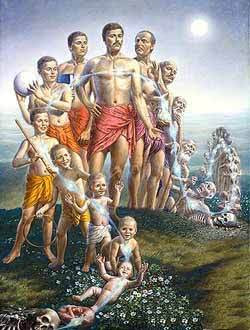
Reincarnation
The memory residue from our past lives informs our current lives. It provides what we think of as our essence, the innate ‘me-ness’, beyond our current physical reality. As we can see from dream recall, this is going to consist mainly of behaviour patterns, we call them innate traits. There will be to a lesser degree a general emotional background, collected from all our past lives, we may be optimistic, pessimistic, depressive, rational, etc. To a greatly diminishing degree will be imagery, what we call past life memories, which we will only glimpse unless we deliberately work to remember them. Finally, abstract knowledge is lost to all but the most capable shaman, names, dates, places, knowledge about particular subjects, the ability to perform learned motor skill tasks like driving or playing an instrument. As a parting though, perhaps those shaman who undertake dream-work and manage to achieve lucidity in the dreaming state, can also achieve lucidity in the incarnated state and perform seemingly magical and supernatural feats?

Tumbleweed Whirlwind


A whirlwind of tumbleweeds! WHEEEE!!!!


Tuesday, 10 August 2010

Worldwide Didgeridoo Meditations

Four times a year people all over the world take part in this didgeridoo sound healing meditation wherever they are. The didgeridoo meditation happens on the equinoxes and solstices at local sunset times. It is like a wave of healing sound following the sunset around the globe four times a year.


So the meditation starts in New Zealand (since they are the first large land after the date line); soon after participants in Australia, Taiwan, Japan and other Asian countries join in; the wave will then be carried on by participants in Arab countries, Israel, Africa and Europe with Americans, Canadians, Middle and South Americans complete the world wide circle.

We will do this didgeridoo meditation at every solstice and equinox, so we will join our global energy playing didgeridoo four times a year. Join our growing worldwide didgeridoo circle in this regular meditation, the next one will be on 23 September 2010. Wherever you are on this beautiful planet on 23 September 2010, please allow for one hour starting at your local sunset time. If you cannot set that hour apart, be with us in spirit as much as you can during that hour.

For more information, follow the following link

Coventy Well

This is a small sacred well on the outskirts of the town Great Torrington, in North Devon.  It is located on the commons, just past the old bowling green.  In the 14C lepers from the nearby village of tadiport (famous for its leper fields and Leperfest every year) would go to the well and use the healing waters to help cure their condition.

Coventy Well, Torrington Commons, North Devon


This well was probably one of many dedicated to the Romano-british goddess of wells and springs, Coventina.  Coventina was once much revered and there is still a shrine to her in Northumberland, near Hadrians Wall.  It is thought that the river Tyne and the City Coventry both got their names from Coventina.

Coventina, Goddess of wells and springs.


Coventy well is contained in the copse of trees in the centre of the map.


View Larger Map

Brain and Mind

The brain no more contains the mind 
than your PC contains the internet.
Article from The Phoenix Blog
 

Monday, 9 August 2010

Ten Canoes (DVD)

Ten Canoes

Ten Canoes

This is a wonderful film about Aborigianl Australians filmed in their own language (with subtitles, that are to be honest, rather difficult to read) It follows a young initiate on his goose egg gathering mission and his education by an older and wiser tribal elder. The story the elder tells the initiate is from the dreaming and follows the exploits of one of their ancestors. A very watchable, informative and interesting film. The extras on the DVD are also well worth a look.

Doing and Boing Rating 5/5